
A Practitioner's Guide to Paid Search Incrementality | Part 3 of 3 — What to Actually Do With Your Incrementality Number
The first two posts covered why platform attribution overstates your impact and the four ways to measure what's actually incremental. This is the part most teams skip. It's the only part that matters. It's also where our paid search team spends the bulk of the work, because measurement only earns its keep when it changes a decision.
Recalibrate your bids
The CLS gives you an incrementality estimate, not the calibration factor. Once you've landed on an agreed-upon incrementality number (triangulated across your CLS, geo test, and other reads), you can turn it into a calibration factor and plug it straight into your bidding.
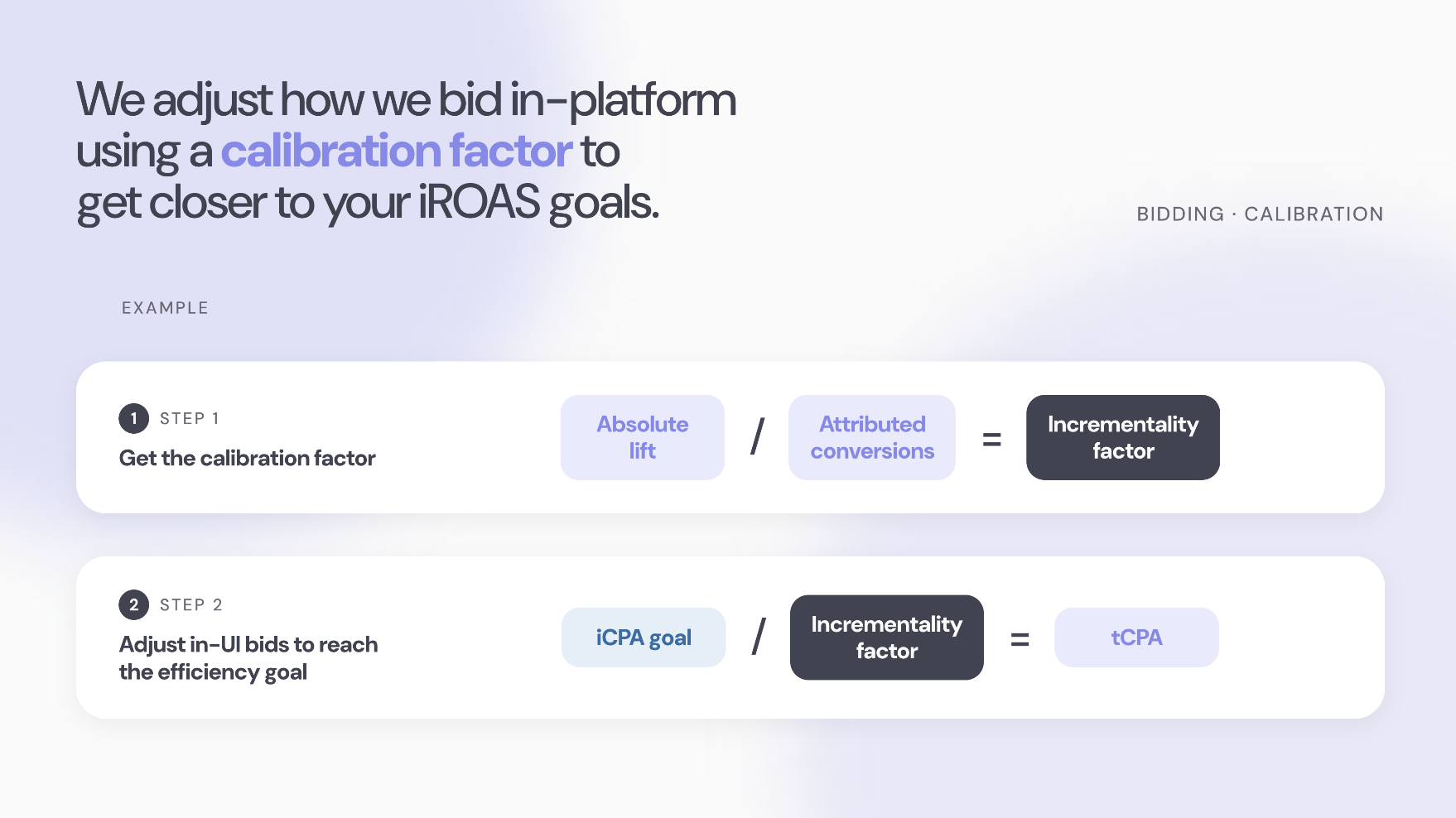
If your true breakeven iCPA is $X and incrementality is 59%, your tCPA in Google Ads should sit at roughly 0.59 × $X. That's the bid that delivers a profitable incremental customer, not a profitable platform-reported one. It's almost always lower than what teams are running today, and we know that's a tough adjustment for anyone defending the headline performance numbers.
For Brand Search at 19% incrementality, the math gets even tighter. Most accounts are dramatically over-bidding on brand and paying Google to capture demand they already own. We've seen that play out before the data was in. There's no shame in the starting point. There's only the question of what you do once you know.
Stop treating all conversions as equal
The aggregate factor hides variance underneath. Customers who came in via Google last-click and said "Google" on a "How did you hear about us?" survey are highly incremental. Customers who came in via Google last-click but said "TV" are barely incremental at all. Bucket conversions by these signals in your internal attribution and weight them accordingly. The blended average should land back at your aggregate factor.
Don't assume incrementality is static
This is the one our team sees most often, and we've been guilty of it ourselves. Incrementality moves with your bids, your budgets, your audiences, and your creative. A 40% bid reduction in the client's geo test cut incrementality nearly in half. Whenever you change a major lever, remeasure. Otherwise you're optimizing on a number from a state of the account that no longer exists.
Even when nothing major has changed on your end, incrementality still drifts. Competitor activity, seasonality, organic SERP changes, audience saturation, and platform algorithm updates all quietly move the number underneath you. That's why we recommend a recurring testing cadence, not just event-driven remeasurement. For most accounts, a quarterly CLS on your largest spend channels plus an annual geo holdout is a healthy baseline. The goal isn't to run a test every time you tweak a bid; it's to make sure the number you're calibrating against is never more than a quarter or two stale.
Use multiple methods
No single test is definitive. The conviction in our DTC client's program didn't come from any one experiment. It came from four very different methodologies pointing in the same direction. When your CLS, your geo test, and your accidental pause all agree, you can act with confidence. When they disagree, that's a signal too, and our team treats it as a prompt to dig deeper rather than pick a favorite.
Where this fits in your measurement stack
Incrementality doesn't replace MTA or MMM. It calibrates them.

MTA is fast and tactical but measures correlation. MMM is broad and privacy-safe but slow and expensive. Incrementality is the only one that gives you causal ground truth, and you can use it to recalibrate the other two.
The catch: per BCG and Google's research on 2,135 global companies, only 46% of organizations actually use all three together, despite individual adoption rates of around 80% for each. Only 9% of companies consider their measurement AI capabilities "leading." We don't share those numbers to shame anyone. We share them because most teams we meet are doing their best with the tools they have, and the gap is structural, not personal.

The top-tier mindset
Here's what our team tells every client at the start of an engagement: the platform dashboard is a measurement layer, not the answer. Google can tell you what it observed. It cannot tell you what it caused. Those are different questions, and you need different instruments to answer them.
The teams that win don't ask whether to do incrementality testing. They ask how often, with which methods, and what to do with the answer. They expect Brand Search to look worse under the microscope. They expect Non-Brand to look more expensive than the dashboard implies. They build their bid strategy, their attribution model, and their channel mix around the actual answer, not the convenient one.
That's how you stop fighting the algorithm and start architecting around it. And it's the work our paid search team at Pearmill genuinely loves doing alongside clients who are ready to look at the numbers honestly.
Want the full program in one place? We're walking through it live, including the geo test cell designs and the calibration math, in our upcoming workshop. [Register here]. The complete practitioner's guide will be available as a downloadable report afterward.





The author





.svg)


