
How we scale a Meta account for Black Friday (and the one rule we break)
Scaling a Meta account is mostly about not breaking the thing that's already working. Most of the year I follow the rules. In Q4, I break one of them on purpose. Here's how we think about scaling, the rule we break, and how to read the platform once you've pushed the budget.
First, creative is king
Before any of this: creative matters more than scaling tactics, campaign structure, or events. It's the number one lever to pull. Most of our testing effort goes into creative, because the best budget strategy in the world can't save a weak ad. Everything you read after this assumes you've already done the work to have winners worth scaling.
(Read here how we run creative testing campaigns.)
The standard rule: < 30% every 72 hours
Meta's guidance, and what we've seen hold true across platforms, is to scale no more than about 30% every two to three days. The reason is stability. Jumps beyond roughly 30%, up or down, reset the campaign's learning. Smaller accounts retain a little more when they jump, but the principle holds: move in steps, give it 72 hours, and let the algorithm keep what it has learned. If you have time before your date, you simply walk it up. Going from 10k to 30k can look like: 13K, 16K, 20K, 23K, 27K, 30K, one step every three days as long as performance allows.
The rule we break
Q4 doesn't give you that kind of time, so we break the 30% rule on purpose. Say the daily budget is 10K and I need to get to 30K. Instead of creeping up, I overshoot: send it straight to 35K, then scale back down to 30K a day or two later.
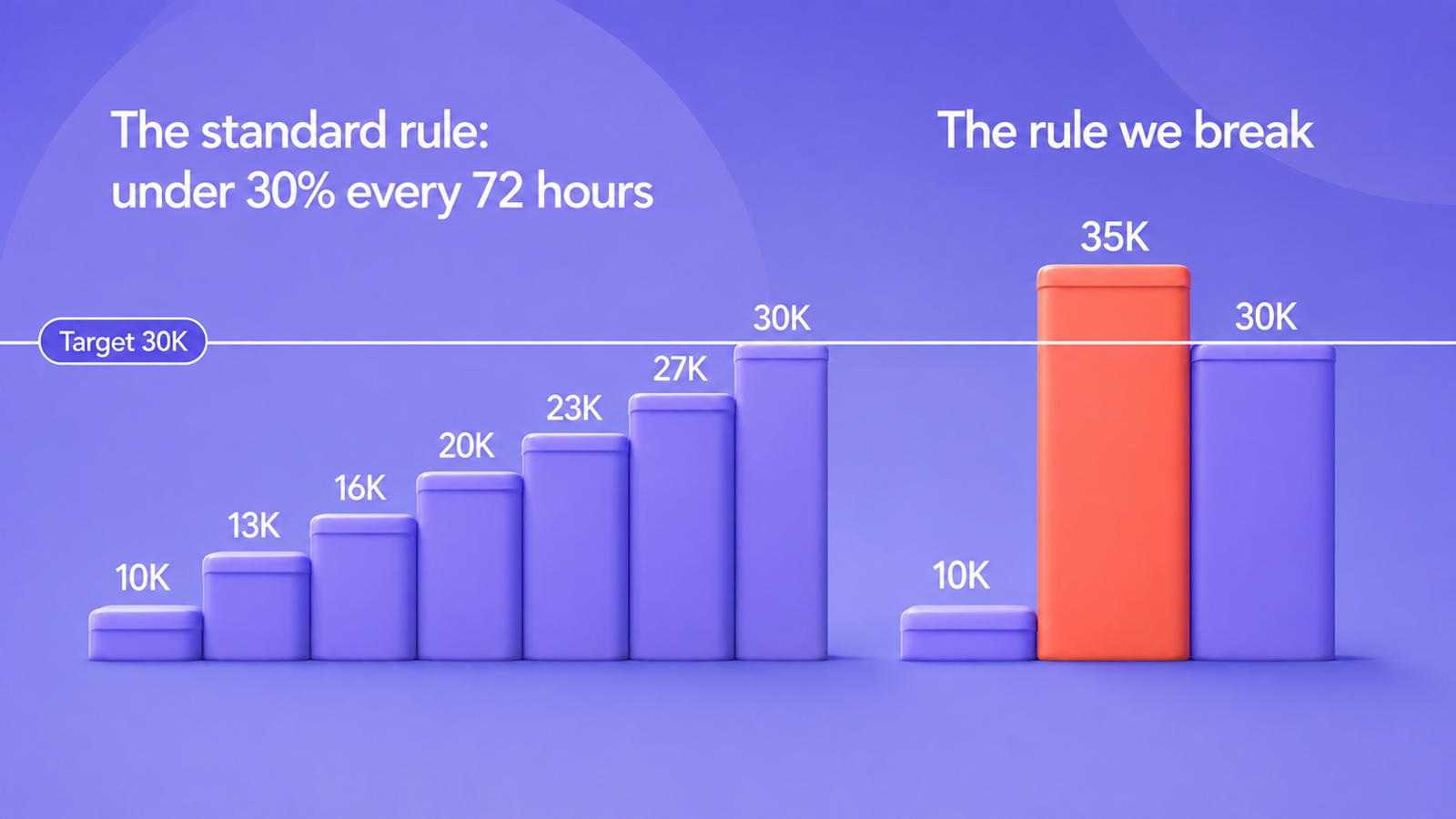
The overshoot is a signal. It tells Meta "we are ready to spend, go find the performance." Then scaling back down, also aggressively, sends the opposite message: "if you don't deliver, we cut." Depending on how volatile the account has been historically, the path might be 10K to 20K to 35K to 30K, or 10K to 40K to 35K to 30K. You are using the budget itself to communicate.
The parking lot
Here is the model for what you're scaling into. Picture a parking lot with 100 spots and 105 cars that want in. That's a normal day in the ad auction: demand a little ahead of supply. On Black Friday and Cyber Monday, Meta opens more of the lot, say 200 spots, but now 300 cars want in. Demand grows faster than supply, so the price to park spikes.
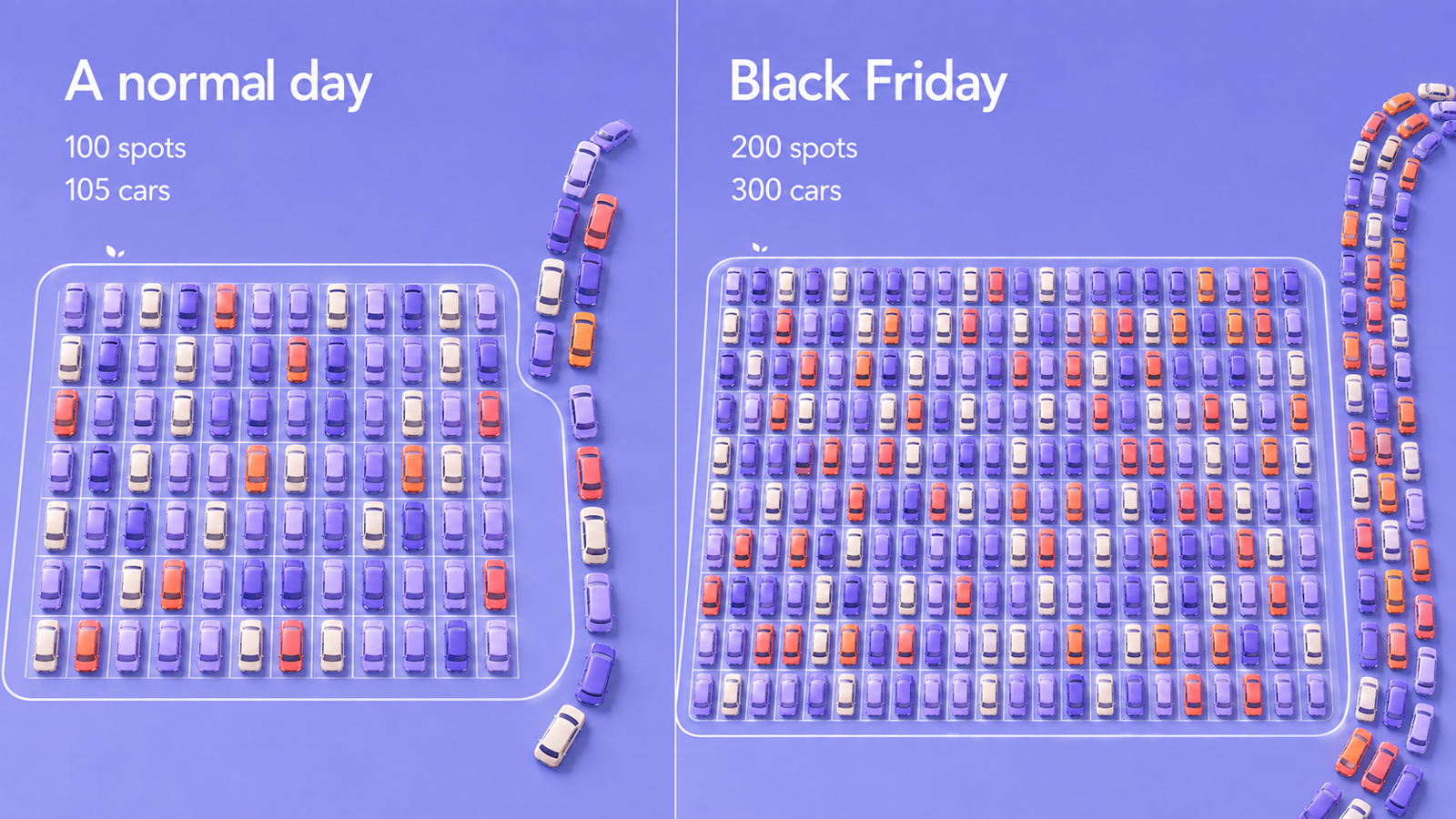
Two things follow. First, Meta keeps the lot fair. Even if you are a billionaire, you can't buy every spot. It hands most advertisers one spot, some a second, some a third. That is exactly why the overshoot works: you are not buying your way in, you are signaling that you deserve more spots and can fill them. Second, the cars that win spots on the busiest day are the ones with the strongest offer. Scale hard, but scale behind a real deal, or you are paying peak prices to lose the auction.
How to read it after you scale
Push the budget, then read the platform in two layers.
On-platform, watch CPM, CTR, and CPC. CPC is your summary stat, because it holds CPM and CTR together. If CTR climbs but CPM climbs faster, CPC goes up. If CPM climbs but CTR climbs faster, CPC comes down. So CPC tells you the net story in a single number.
On conversions, watch add-to-cart, checkout, and purchases. If the funnel is long, look mostly at add-to-carts and checkouts on day one after a scale.
Then decide. If everything is bad across the board, on-platform and conversions, scale down the next day. If the on-platform numbers look good and only purchases are lagging, wait. Those are almost always delayed conversions that land a day or two later, and Meta reports them late. Don't panic-cut good delivery.
One timing rule: don't scale aggressively on a Friday (except Black Friday). Scale Thursday, watch Friday, adjust Saturday if you need to. You want a full day of clean data before the weekend, not a mystery.
What the ramp actually looks like
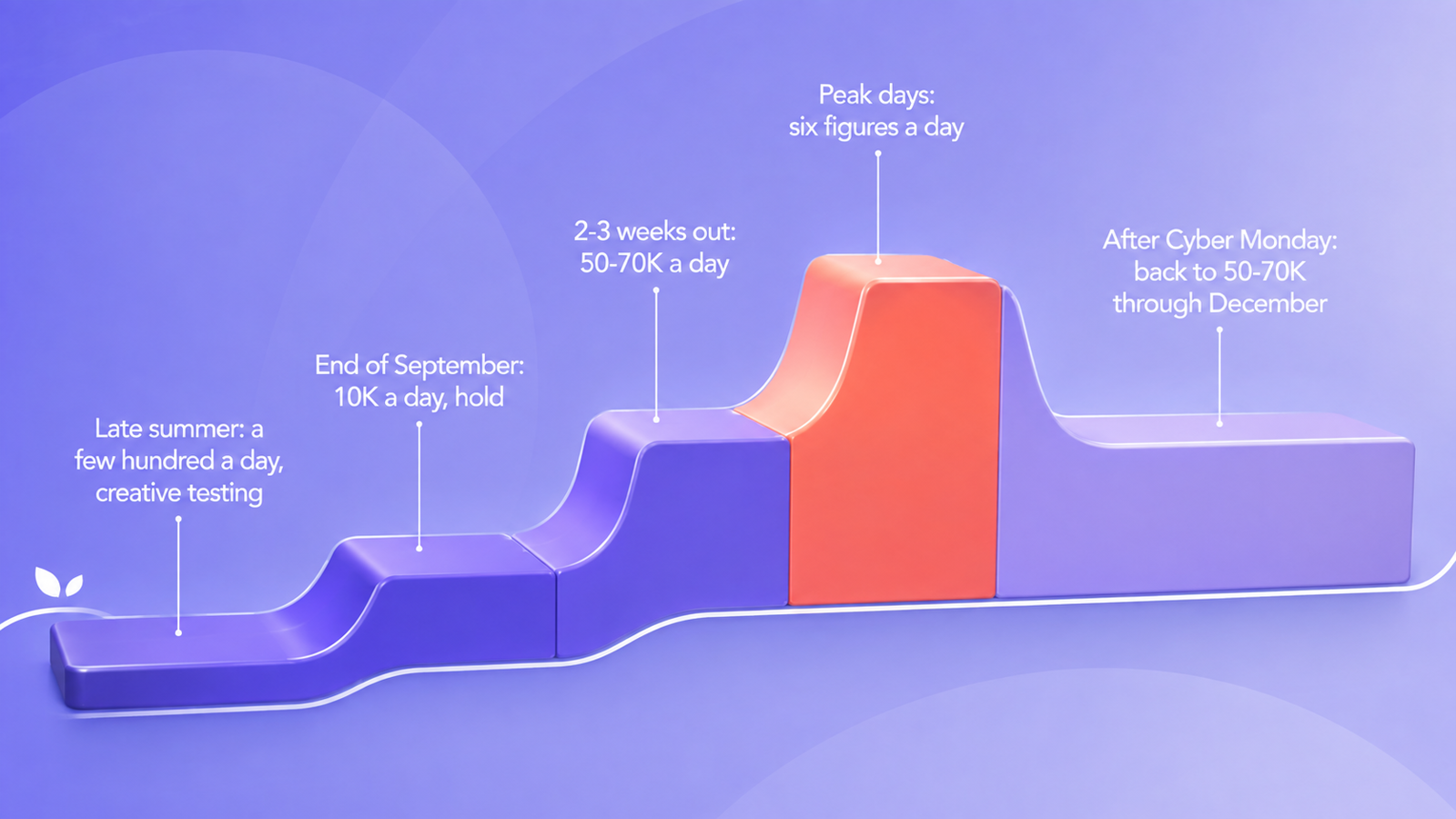
Concretely, here is the shape of a Q4 ramp on a brand we've run for five years. Right now, in late summer, we're spending a few hundred dollars a day, deep in creative testing rounds, not scaling at all. The plan is to reach around 10K a day by the end of September and hold there until two to three weeks before Black Friday. Then, if performance holds, we push to 50-70K a day in the run-up. On the peak days we scale into six figures a day. Across the weekend we actually scale down on Saturday and Sunday, because at those levels the pullback doubles as our "perform or we cut" signal. After Cyber Monday we drop to a cruise speed (those 50-70k) and hold it through the December sell-out.
Scaling down is a tool too
Scaling isn't only up. If we're beating our targets and we'll sell out too early, I pull budget back rather than pour more in. I almost never fully pause, though. Going dark for more than about three days resets your learnings, so I would rather drop from 10K to 7K to 5K and climb back up than switch it off. Momentum is worth protecting. And efficiency is the real goal: selling out three weeks early isn't a win, it means you spent more than you needed to. Aim to sell through right up against your cutoff date, not far ahead of it.
The short version
Scaling is budget as communication. Move in steps when you have time, overshoot and pull back when you don't, read CPC and your carts before you react, and never fight for a parking spot on the busiest day of the year without a real offer in the car.





The author




.svg)


