
We Spend ~10% of Revenue on AI. We're Also Hiring More Marketers. Here's Why.
On October 14 at 11am ET, Pearmill CEO Nima Gardideh will walk through how to build a marketing organization where more people can turn signals into revenue, and why AI's real payoff is learning velocity, not output velocity. This post previews the argument. Register here.
AI is a force multiplier, not a staff reduction tool
The simple AI story goes like this: AI displaces people, removes jobs, and will cause layoffs across the board. Same work, fewer people. If that story were true, an agency like Pearmill would have every economic incentive to act on it. We sell the time, judgment, and output of marketers.
That is not what is happening. We are hiring. The work is getting more ambitious. The bar is going up. And this is not coming from an AI skeptic: roughly 10% of Pearmill's revenue now goes to AI tokens, we have our own AI connector and advertising intelligence layer, and consider ourselves very AI-pilled. It is not a side experiment. It is part of how our company operates.
What is changing fastest is not output. It is the quality ceiling, and the rate at which the team can learn. AI matters, but not because the end state is a smaller version of the old org chart.
Learning velocity over output velocity
Most AI adoption gets framed around output velocity. More ads, more pages, more reports, more variants, more ideas. That matters, and we do not dismiss it.
For marketing, the bigger unlock is learning velocity. Can the team ask better questions? Test faster? See more clearly? Update its judgment sooner? That is what connects back to revenue. Knowing what to do is usually harder than making the thing.
As marketers, we are ultimately bottlenecked by our ability to capture attention and demand. How we well we learn to do that for our different customer segments and markets is how we succeed.
The “Chief Marketer” loop, and why handoffs break it
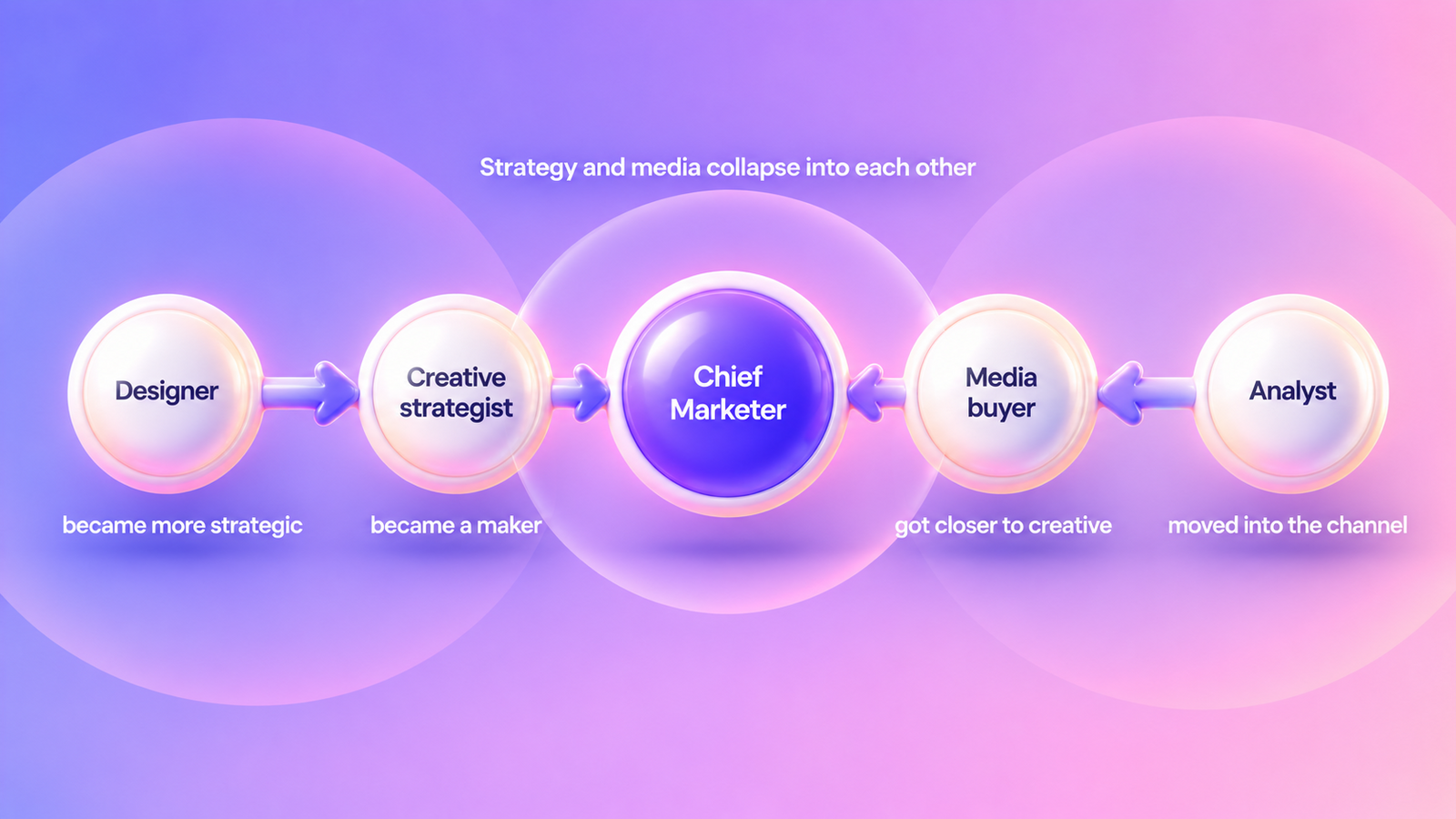
A Chief Marketer, as recently coined by the folks at Runneth, is someone with the range to run the whole learning loop: understand signals, build a strategy, execute, measure, and connect it back to revenue. They do not need to be world-class at every step. They understand enough of the whole to ask better questions and move faster.
Most marketing organizations are not built for that. They are built around functional handoffs. Strategy interprets the market. Creative makes the work. Production ships it. Media distributes it. Analytics reports back. Then strategy updates again, often too late.
The problem is that context leaks at every handoff. The strategist knows why the bet matters. The creative team sees something in the work. The media buyer sees something in the channel. The analyst sees something in the data. By the time those observations travel through the org, the learning loop is slow and lossy.
.png)
The obvious failure mode of AI adoption is to keep that org chart and make every silo faster. More briefs, more concepts, more versions, more tests, more reports. The loop is still broken. You have not transformed the organization; you have made the old one move faster. If it had weak judgment or slow learning before, AI amplifies that too.
The new goal is not that everyone becomes the same person. Titles, specialization, and taste still matter. But the boundaries between them get more porous. At Pearmill, the first sign was role collapse: designers became more strategic, creative strategists became makers, media buyers got closer to creative, and analysts moved into the channel. AI did not make every role irrelevant. It made every role adjacent.
The bottleneck moved
When execution is expensive, the bottleneck is who can make the thing. Who can design it, write it, build it, analyze it.
When execution gets cheap, the bottleneck moves to what is worth making. What is actually true? What is the right bet? What will move revenue, and what will teach us something?
That is why judgment becomes more important, not less. The more production cost trends toward zero, the more expensive bad judgment becomes.
.png)
How Pearmill has transformed into an AI-native agency
Pearmill was not born AI-native. We had to transform into this, and the mistake would have been to tell everyone to use AI more. That creates scattered usage, not organizational learning. So we built systems.
- AI training. Train for range, not to turn everyone into an engineer. Teach people how to build AI workflows, how to adopt AI skills, connectors, and plugins.
- A central skills database. When someone finds a useful workflow, it becomes shared infrastructure, not a private trick trapped in one person's chat history. We use Notion’s skills system.
- OKRs tied to business outcomes. Not "use AI more," but "use this workflow to improve a real business loop."
- Custom tools and MCPs. Generic tools are not enough when the real work depends on your systems, your data, your context, and your actions. We’ve built our own.
The technology matters. The operating system around it matters more.
Where to start
If you lead a team, do not start with "where can we use AI?" That is too broad. Start with one question the team currently cannot afford to ask. Maybe it is about creative quality, customer fit, sales feedback, or measurement. Build the workflow around that question. Make it reusable. Tie it to an outcome. Train people to run the loop.
The companies that win will not just have one person who can turn signals into revenue. They will build teams where more people can move across that loop, and AI is how they learn fast enough to do it.
Join Nima Gardideh live on Wednesday, October 14 at 11am ET for the full talk, the client example in detail, and a Q&A on how to apply it to your own team. Register here.




The author





.svg)


